
The 2026 Target restock guide: consistent execution on a Shape-protected storefront
Target restocks move fast and punish sloppy setups hard. Trading cards, consoles, limited collectibles—when inventory lands, the window is seconds wide. This guide gives you the execution sequence and configuration framework to be ready before the stock appears, not after.
Target runs Shape Security across its checkout flow—a behavioral analysis layer that has ended the viability of most API-based and headless tools. The consistent path forward is browser-native execution: a real Chrome session, a real user fingerprint, a real checkout path. Vectorcart's Target lane received a certification detection fix in March 2026, improving checkout-stage reliability and formalizing it as a Verified Expansion lane.
1. Understand what Target's Shape Security layer actually does
Before configuring any execution workflow, you need to understand the defense you are operating against. Shape Security (now integrated into F5's platform) does not simply block known bot IPs. It analyzes behavioral patterns across the entire session: mouse movement patterns, keyboard timing, scroll behavior, tab focus events, and TLS fingerprint consistency.
- Headless detection: Scripts running in headless Chrome or via API calls lack the rendering signals of a real browser. Shape identifies the absence of these signals as a bot indicator, typically before the add-to-cart request reaches the server.
- Session coherence: Shape tracks whether a session's behavioral chain is internally consistent. A session that navigates instantly from page load to add-to-cart without any intermediate events fails coherence checks.
- Cookie hygiene: Shape assigns session tokens that degrade if the session context changes mid-flow—switching IPs, clearing cookies between steps, or injecting headers that do not match the established session fingerprint.
2. Build your Target account to a clean, checkout-ready state
Account state on Target is a harder dependency than on most other retailers. The session must meet several prerequisites before the execution window opens. Missing any of these will stall checkout at a stage where recovery is impossible during a live restock.
- Saved address required. Target's checkout does not reliably support address entry during a live session under Shape pressure. Your shipping address must be pre-saved in your account's address book.
- Saved payment method required. Credit or debit card stored in your Target account. PayPal and Apple Pay checkout paths introduce additional redirect steps that extend checkout time significantly.
- No pending account flags. Accounts with recent purchase disputes or policy holds will be interrupted at the payment stage. Verify your account is in clean standing before a high-priority restock day.
- Target Circle membership is optional but recommended. Circle members sometimes receive slightly earlier access signals on certain restocks and the Circle price-match layer is not an interruption point if pre-enrolled.
3. Configure inventory monitoring at the SKU level, not the product page
Target product pages frequently show a parent listing before individual SKU availability resolves. Monitoring at the parent page level introduces a delay: the page must load, resolve the in-stock variant, and then trigger cart action. Configuring at the SKU level removes that resolution step.
- In Vectorcart, enter the direct DPCI (Target's internal SKU identifier) or the specific product variant URL rather than the category or parent page. This pins the monitor to the exact inventory unit you want.
- For trading card sets like Pokemon TCG or sports card packs, individual SKUs frequently have different restock timing within the same product family. Monitor each SKU independently for the highest precision.
- Enable inventory health polling in Vectorcart.app. The dashboard will surface backend stock signals before the product page visually switches to "Add to cart," giving you the earliest possible trigger.
- Set your polling interval appropriately. Excessively aggressive polling on a single session can trigger rate-limit responses from Target's edge layer. Use Vectorcart's recommended interval for the Target lane.
4. Why browser-native execution outperforms headless tools on Target in 2026
Shape Security's deployment on Target has matured to the point where headless tools—regardless of how sophisticated their stealth patches are—face declining reliability. The core problem is architectural: headless environments cannot produce authentic rendering signals because they are not running a real browser graphical stack.
Vectorcart's v5.0 execution layer operates inside a standard, headed Chrome tab. Every signal that Shape analyzes—TLS fingerprint, JS execution timing, rendering events, cookie structure—is generated by the real Chrome engine, not synthesized. This means the session that executes a Target checkout through Vectorcart is, from Shape's perspective, a standard Chrome user session.
This is the reason the Target lane received certification-level verification in March 2026. Repeatable checkout-stage evidence was collected across multiple session types and product categories, confirming that the browser-native path produces clean, consistent execution where API-based approaches were failing.
5. Proxy strategy for Target: what works and what gets flagged
Target's proxy sensitivity is different from a standard Shopify store. Shape's session analysis includes IP reputation scoring, but the session behavioral signals carry more weight than the IP classification alone. This means proxy selection is still important, but it is not a substitute for having a clean session structure.
- Residential or ISP proxies are the baseline standard for Target. Datacenter IPs carry higher Shape risk scores and will flag sessions at a higher rate, particularly on limited-stock events when Shape's sensitivity is elevated.
- Bind one proxy per session. Do not rotate proxy endpoints mid-session. Changing IP mid-flow breaks session coherence and triggers a Shape flag. Set your proxy before the session starts and do not change it.
- Validate proxy health before the restock window. Vectorcart's dashboard shows live proxy health scores. Swap any failing proxies at least 10 minutes before a known restock time—not during the live window.
- Geographic match matters. If your saved shipping address is in the US, use a US proxy. Address-to-session geographic mismatch is a low-effort flag for behavioral analysis systems.
6. High-demand Target restock categories: how execution differs by product type
Not all Target restocks behave the same way. The product category affects how inventory is loaded, whether quantity limits are enforced at checkout, and how quickly the window closes.
- Trading cards (Pokemon TCG, sports cards): Extremely fast sell-through. Individual pack and bundle SKUs frequently restock independently. Monitor SKU-level, not category-level. Quantity limits (usually 1–2 per transaction) are enforced at the item level and sometimes at the account level on high-demand sets.
- Electronics and gaming consoles: Restocks are less frequent but higher value. Shape sensitivity is elevated during console restock events. Session warmup is critical—a cold session attempting a console checkout is a higher-risk execution than a pre-warmed session.
- Limited collectibles and exclusives: Target exclusives (specific toy lines, entertainment exclusives) operate similarly to trading cards in speed. These often appear in-stock before the product page reflects the change, making inventory health polling the key advantage.
- Everyday restocks: General out-of-stock items that restock regularly (personal care, household) are well-suited to a persistent monitoring task without urgency timing. These are where Basic-tier execution handles the workflow without Pro's multi-account capabilities.
7. Post-restock replay review: build a repeatable system
A single successful checkout is data. A consistent track record across multiple restock events is a system. Use Vectorcart's replay and history logs to build toward the second, not just the first.
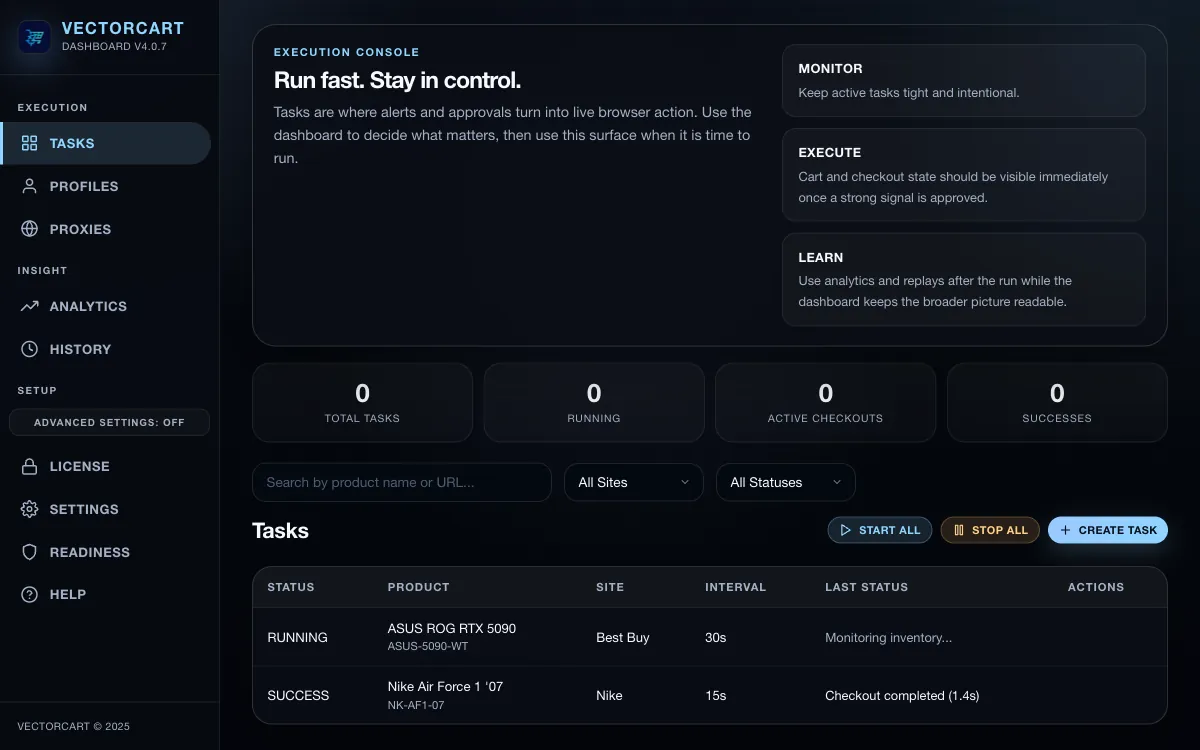
- Open Vectorcart's Replay view after each event. Execution timing, stage completion, and failure classifications are logged for every task run.
- Classify failures before adjusting configuration. Shape blocks, checkout-stage stalls, account-state interruptions, and proxy failures each have a different root cause and require a different fix.
- If your log shows Shape-layer blocks: review session warmup state and proxy type before the next run. Do not simply retry the same session configuration.
- If your log shows checkout-stage stalls: check saved address and payment method in your Target account. A missing field that requires manual entry during checkout is the most common cause of stage-level failure.
- If your log shows monitor-level delays: check your SKU-level configuration. A parent-page monitor that requires variant resolution adds a predictable lag that SKU-level targeting eliminates.
8. Frequently asked questions: Target restocks with Vectorcart
Does Vectorcart support Target restocks?
Yes. Target is a Verified Expansion lane in Vectorcart. A certification detection fix was shipped in March 2026, improving checkout-stage reliability across electronics, trading cards, and limited collectible categories.
Why do most Target bots fail in 2026?
Target uses Shape Security, a behavioral analysis layer that identifies headless browsers and API-based automation by fingerprinting session signals. Vectorcart runs inside a live Chrome tab, bypassing headless detection by operating as a real browser session with authentic signals.
Does Vectorcart work for Target trading card restocks?
Yes. Pokemon TCG, sports cards, and trading card products on Target.com are among the highest-volume restock categories. Vectorcart's monitor tracks inventory state at the SKU level and triggers cart execution as soon as stock appears.
Do I need a Target Circle account?
A Target Circle membership is not required for standard checkout, but an active account with a saved address and payment method is required. Guest checkout flows are not currently supported in the Vectorcart Target lane.
What proxy type should I use for Target?
Residential or ISP proxies are the baseline standard. Datacenter IPs carry a higher Shape risk score. Do not rotate proxy endpoints mid-session—bind one proxy per session and keep it consistent through checkout completion.
Should I use Basic or Pro for Target restocks?
Basic supports single-session execution and is sufficient for everyday restock monitoring. For high-demand events requiring multi-SKU monitoring, proxy group management, and ACE-assisted checkout, Vectorcart Pro is the appropriate tier.
Does Vectorcart guarantee a successful checkout on Target?
No. Vectorcart provides the execution infrastructure and verified workflow. Actual checkout outcomes depend on account state, proxy quality, inventory availability, and retailer behavior. See our Terms for the full scope.